Civil Rights
Reconstruction, Unfinished
Context & Analysis Supporting the Above Film
Editor’s Note — Reconstruction, Unfinished Series
This essay accompanies the above video and is part of American Renewal 1870’s Reconstruction, Unfinished series. It is not a retelling of the film, but a companion analysis intended to anchor its claims in historical and legal context.
When Dr. Martin Luther King Jr. declared, “We’ve come to Washington to cash a check,” he was not speaking in metaphor. He was naming a debt already recognized — but unpaid — in American law.
What the video illustrates is simple and often misunderstood: civil rights was never conceived as symbolism or inclusion alone. It was designed as repair.
The Civil Rights Act functioned as the first enforceable attempt to honor that obligation. It targeted access to jobs, education, housing, and federal opportunity, the very areas from which Black Americans had been systematically excluded since emancipation. In Reconstruction terms, it was not generosity. It was delayed correction.
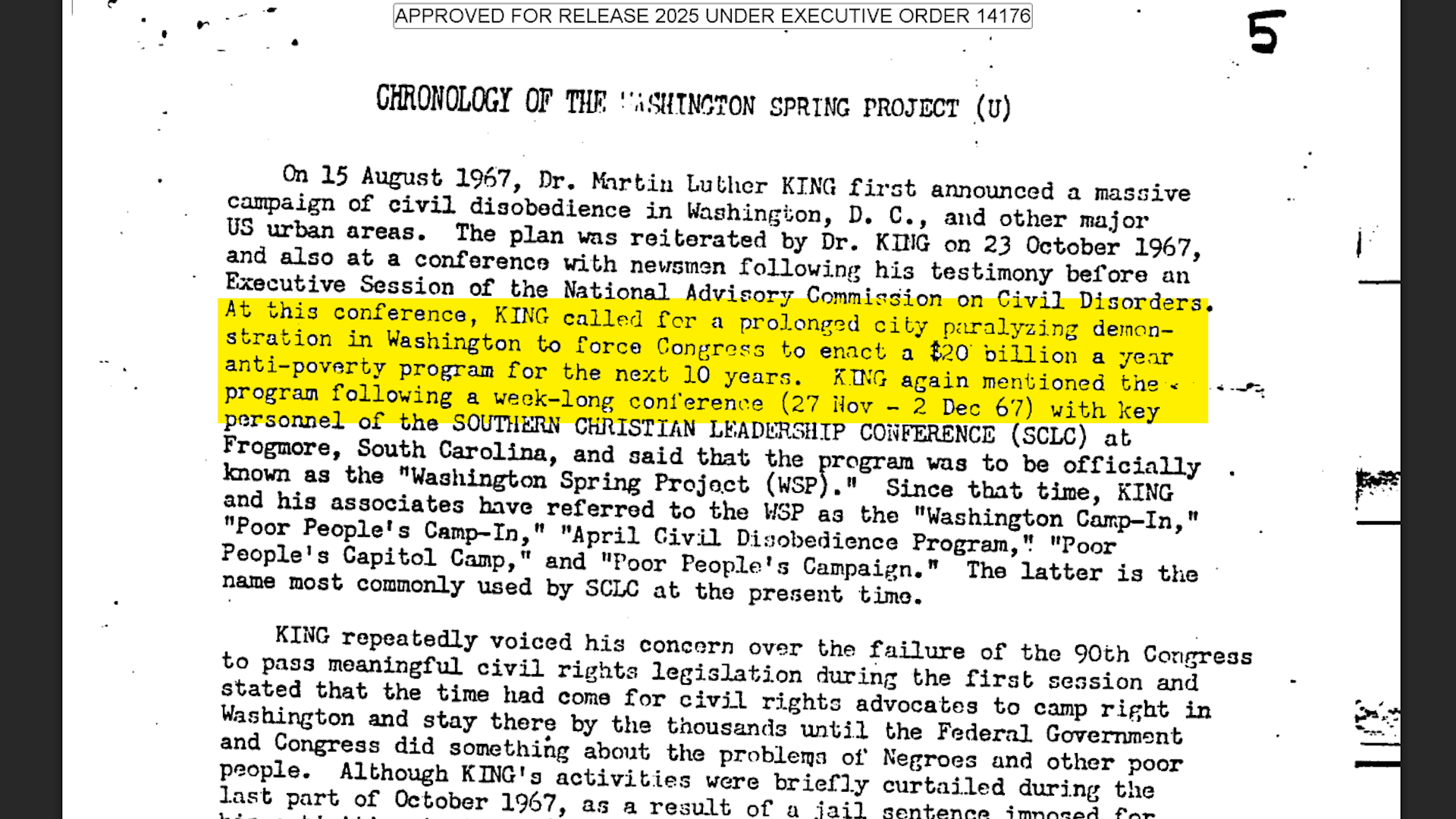
But Dr. King understood that legal access alone could not settle centuries of extraction. By 1968, he was preparing to return to Washington to demand a second check — Valued at roughly $20 billion per year for a decade, the proposal approaches $2 trillion in today’s dollars.
That demand was never made. King was assassinated in April of 1968 before the march could occur.
What he also did not live to see was the administrative redirection of the first check. Just 48 days after the Civil Rights Act became law, Executive Order 11246 altered how civil rights would be enforced. Without changing the statute, enforcement expanded to include other groups and later evolved into affirmative action and diversity frameworks.
The law remained intact.
Its original beneficiaries did not.
Over time, women, immigrants, and other minority groups advanced through widened enforcement channels, while the descendants of slavery, the people the statute was written to repair, were pushed behind an ever-growing coalition structure. Civil rights shifted from a corrective remedy into a general inclusion program.
Years later, an unlikely voice stated the historical truth plainly. Ann Coulter observed that America owed a debt for slavery and Jim Crow, and that debt was owed to Black Americans. Set aside the messenger. The substance aligns with the original design of civil-rights law.
Today, the rescission of EO 11246 under President Trump forces a long-avoided reckoning. With the administrative buffer removed, the Civil Rights Act must finally answer the question it has deferred for decades: who was it written to repair?
This moment presents both risk and opportunity. It may open a path for the descendant community to reclaim remedies delayed for sixty years. Or it may fracture political coalitions built atop enforcement drift.
Either way, the confrontation is unavoidable.
Dr. King was not departing from Reconstruction.
He was attempting to complete it.
Civil rights was the legal foundation.
Reparations were always the economic completion.
Reconstruction did not fail — it was suspended.
And the nation has reached the point where suspension is no longer legally or morally sustainable.
American Renewal 1870
“Turning Law Into Repair.”