Who We Are
Our Mission
American Renewal 1870 (AR1870) exists to defend, preserve, and advance the interests, history, and cultural identity of Descendants of U.S. Chattel Slavery.
We are committed to telling the stories that built this nation but were too often erased, ignored, or distorted. Through education, media, historical preservation, civic engagement, and cultural storytelling, we work to preserve the legacy, contributions, struggles, resilience, and achievements of Black Americans whose labor, sacrifice, and innovation helped shape the United States and continue to influence the world today.
At the same time, we engage in advocacy and community-based action that supports the material, educational, economic, and civic advancement of the community. Through coalition building, legislative engagement, public education, and media production, we help ensure that the voices and experiences of Descendants of U.S. Chattel Slavery remain visible, documented, and represented in the public sphere.
Our mission is not only to advocate for the community, but to preserve its historical truth, strengthen its cultural foundation, and ensure future generations understand both the cost of the past and the value of the people who endured it.
Our Origins: The Birth of American Renewal 1870
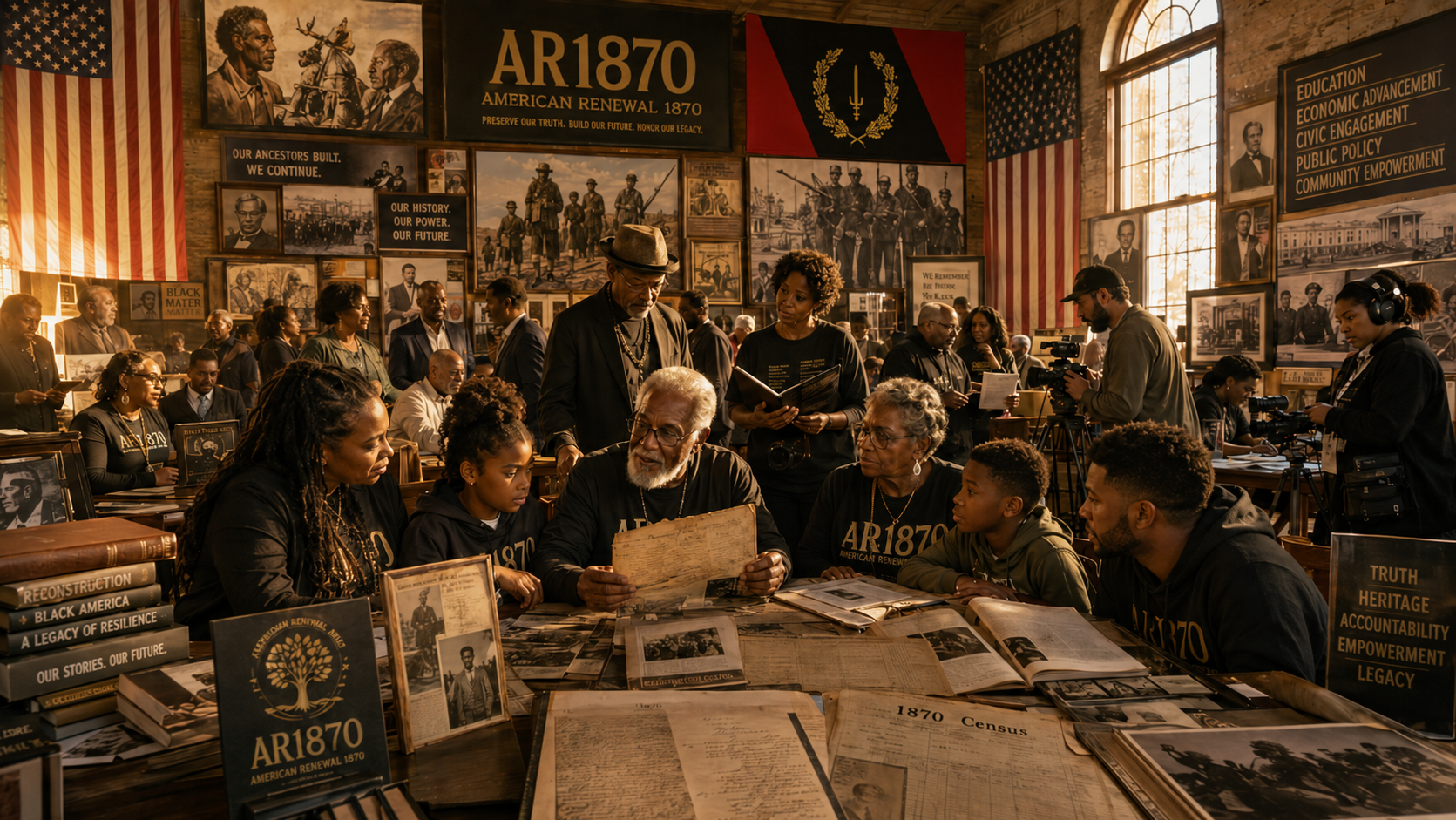
American Renewal 1870 (AR1870) emerged from the unfinished work of reparative justice and the early realization that advocacy alone would not be enough to secure lasting outcomes. Its foundation began in conversations surrounding reparations on Twitter, where a small group of committed individuals came together to bring clarity, discipline, and direction to lineage-based advocacy.
Originally composed of nine to ten individuals organizing in Seattle, King County, and across Washington State, this group worked to advance a precise understanding of reparations grounded in lineage. Through their efforts within the Freedmen Affairs Committee of the NAACP King County branch and broader coalition work, they helped shape the early movement for lineage-based reparations in Washington.
From the beginning, there was a clear understanding that this work would require its own institution. AR1870 was formed to carry forward that mission with permanence, structure, and accountability. Its purpose was not only to advocate, but to ensure that the rights and interests of Descendants of United States Chattel Slavery are protected, enforced, and advanced across all systems that affect them.
The name reflects this commitment. The year 1870 marks the first United States Census in which formerly enslaved Black Americans were recorded by name, establishing a verifiable anchor for lineage. AR1870 centers this standard to ensure that those directly impacted by slavery are not symbolic participants, but the rightful beneficiaries and architects of repair.
The same community these laws were designed to protect is also the origin of a distinct and globally influential culture—one that has driven innovation across music, language, art, economics, and social movements—yet is often extracted from, rather than reinvested into, the people who created it.
AR1870 was built to address both realities:
The organization’s leadership played a role in shaping and advancing Washington State’s Charles Mitchell and George Washington Bush Study on Reparative Action, signed into law by Governor Bob Ferguson. This milestone marked a structural beginning, establishing a lineage-based framework capable of guiding durable legislative repair. AR1870 now carries that work forward as both guardian and enforcer of its integrity.
Our Core Values
Our Values
At American Renewal 1870 (AR1870), our values guide how we preserve history, protect cultural identity, educate the public, and advance the interests of Descendants of U.S. Chattel Slavery. These values shape both our advocacy and our storytelling.
1. Historical Truth and Cultural Preservation
We believe the history of Descendants of U.S. Chattel Slavery must be told truthfully, preserved faithfully, and protected from erasure, distortion, or appropriation.
We are committed to documenting the experiences, sacrifices, achievements, and contributions of Black Americans whose labor and resilience helped build the United States.
We honor the past not as symbolism, but as a living foundation for future generations.
2. Storytelling as Education and Power
Stories shape identity, memory, and public understanding.
Through media, education, film, research, and cultural storytelling, we work to ensure that the voices of Descendants of U.S. Chattel Slavery remain visible, heard, and accurately represented.
We believe storytelling is not only cultural work—it is civic work.
3. Cultural Integrity and Legacy
The culture created by Descendants of U.S. Chattel Slavery is distinct, foundational to American identity, and globally influential.
We recognize this culture as a legacy forged through struggle, creativity, faith, endurance, innovation, and survival.
We believe that culture should not be separated from the people who created it, and we work to ensure that Black American cultural contributions are respected, preserved, and connected back to the community from which they came.
4. Advocacy With Purpose
We believe advocacy must produce meaningful impact for the community.
Through public education, coalition building, legislative engagement, and civic participation, we work to advance the material, educational, economic, and social interests of Descendants of U.S. Chattel Slavery.
Our work connects historical understanding with present-day action.
5. Accountability and Transparency
We believe communities deserve honesty, transparency, and responsible stewardship.
We support accountability in public systems, institutions, and initiatives that affect Descendants of U.S. Chattel Slavery, while also encouraging informed civic engagement and public awareness.
Trust is built through openness, integrity, and consistency.
6. Verification and Documentation
We value facts, records, research, and evidence.
Whether preserving history, analyzing policy, or documenting cultural contributions, we believe truth should be supported by documentation, historical evidence, and verifiable information.
Preserving history requires protecting the record.
7. Community-Centered Leadership
We believe Descendants of U.S. Chattel Slavery should have a meaningful voice in conversations, policies, and narratives that affect their communities and cultural identity.
We encourage informed participation, collaborative leadership, intergenerational learning, and civic involvement rooted in respect for the community’s historical experience.
8. Preservation for Future Generations
We believe future generations deserve access to their history, identity, and cultural inheritance.
Our work is rooted not only in addressing present challenges, but in preserving knowledge, stories, traditions, and historical truth so they endure beyond the current moment.
Core Conviction
History without preservation is forgotten.
Culture without protection becomes detached from its people.
And communities without truthful storytelling risk losing both memory and identity.
AR1870 exists to help preserve the historical truth, cultural legacy, and continued advancement of Descendants of U.S. Chattel Slavery—so that future generations inherit not only the story of survival, but the full story of contribution, resilience, and nation-building.