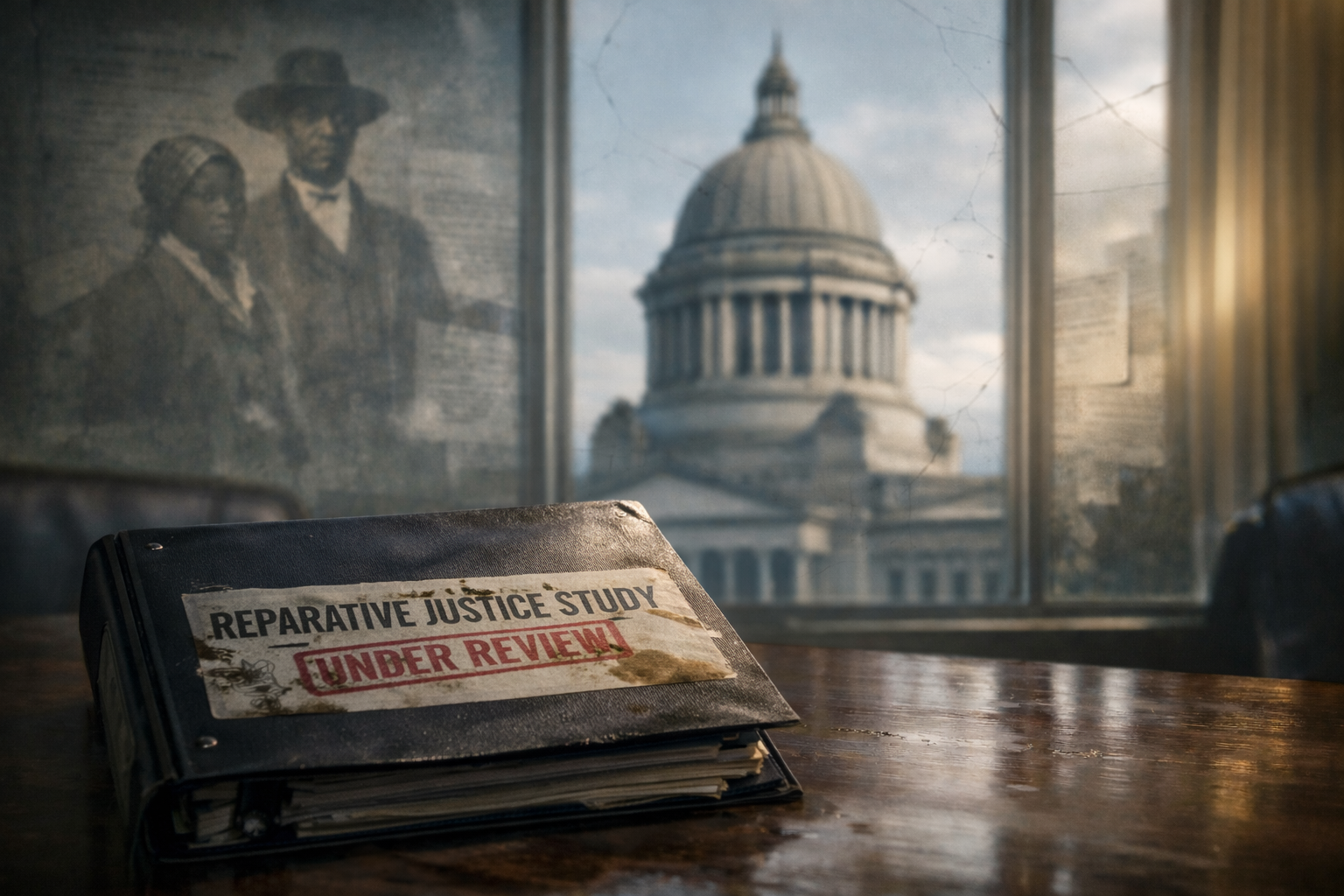


Washington State has taken a historic step by authorizing the Charles Mitchell and George Washington Bush Study on Reparative Action, a study designed to examine the lasting impacts of slavery and discrimination on the descendants of enslaved Africans who helped build this nation and this state. When the legislature and governor approved this work, they did more than fund a research project—they acknowledged a moral and historical responsibility to investigate harms that were never fully repaired. A study of this magnitude carries weight not only for Washington, but for the national conversation on reparative policy.
Because of that significance, the study must be conducted with the highest level of integrity. Integrity in this context means more than simply completing a report. It means ensuring that the research is credible, transparent, and grounded in the purpose of the law that authorized it. Public trust depends on whether the study demonstrates serious scholarship, clear methodology, and a commitment to engaging the community whose history and future are being examined.
The law that authorized Washington’s study established a clear framework: to analyze historical harms, assess their present-day impacts, and produce policy recommendations that could guide future legislative action. This work requires rigorous historical analysis, economic and policy expertise, and a careful understanding of how government systems have affected the descendants of enslaved people across generations. The seriousness of this task demands researchers and institutions capable of approaching the work with both academic rigor and cultural competence.
Equally important is transparency. State-funded research must be open to public scrutiny. Communities must be able to understand the methodology being used, the data informing the conclusions, and the process by which recommendations are developed. Transparency builds legitimacy. When the public can see how decisions are made, confidence in the findings grows. When processes remain unclear, uncertainty follows.

Another essential element of integrity is meaningful engagement with the descendant community. Reparations research is not simply an academic exercise. It concerns the lived experiences, historical memory, and future prospects of a specific community. Genuine engagement means listening to community perspectives, incorporating descendant scholarship, and ensuring that public input helps shape the study’s direction and interpretation.
Community oversight also plays a constructive role in maintaining accountability. Organizations rooted in the descendant community have a responsibility to monitor public processes that affect their constituents. Oversight should not be mistaken for opposition; it is a form of civic participation that strengthens democratic institutions. When community organizations ask questions, request transparency, and advocate for high standards, they help ensure that publicly funded initiatives remain aligned with their intended purpose.
Washington’s reparations study represents an opportunity to set a national example. If conducted with care and integrity, it can produce research that informs policy, educates the public, and advances a deeper understanding of the historical forces that shaped present-day inequalities. Such work can help policymakers move beyond symbolism toward solutions grounded in evidence and historical truth.
History will remember this moment not only for the decision to conduct the study, but for how the study was carried out. Integrity, transparency, and community engagement will determine whether the process strengthens public trust and contributes meaningful insight to the ongoing pursuit of justice.
American Renewal 1870 will continue to follow the study closely as part of its mission to defend the interests of the descendants of U.S. chattel slavery through education, advocacy, and public accountability. Ensuring that the promise of reparative research is honored is not simply a matter of policy—it is part of the unfinished work of Reconstruction.
American Renewal 1870
Guarding the Promise of Reparative Justice
info@ar1870.org | (206) 388-9999 | www.ar1870.org