SERIES
ARTICLE 1
What Birthright Citizenship Was Originally Meant to Protect
Understanding the original constitutional purpose of the 14th Amendment and the protection of freedmen and their posterity.
Clarifying the Record: This Was Never Immigration Policy
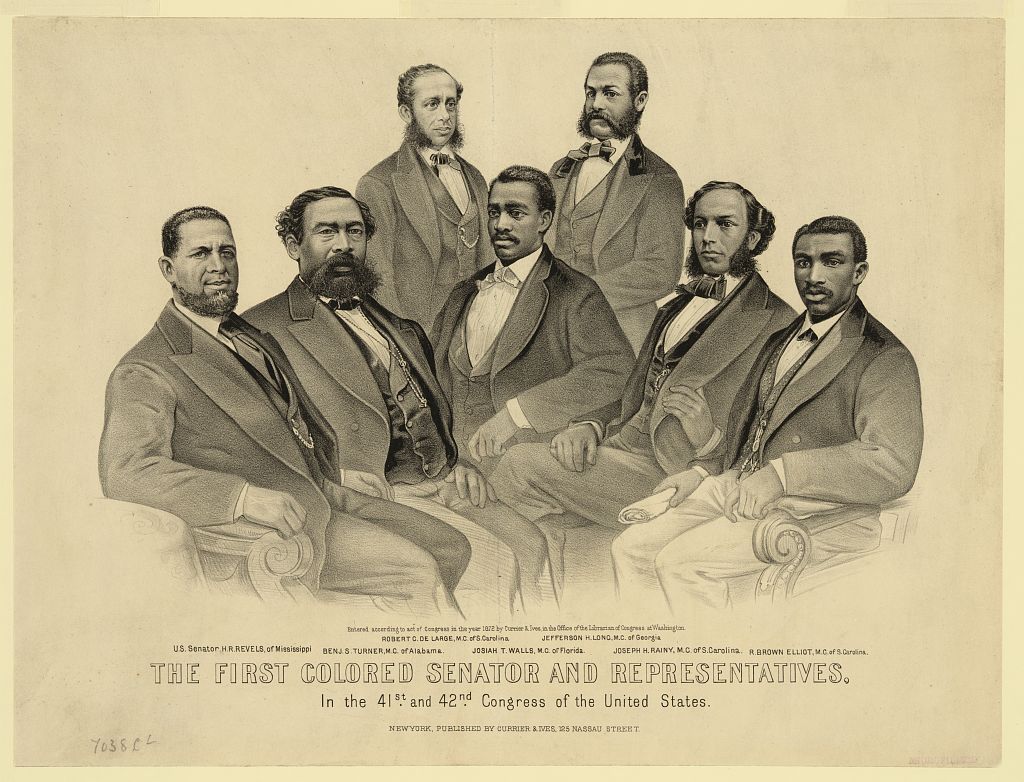
The Reconstruction Amendments—and the laws that gave them life—were not immigration policy. They could not have been. In 1866–1868, the United States was not grappling with mass post–Civil War immigration. The overwhelming majority of people living within U.S. borders at that moment were already here. The constitutional crisis Congress faced was not who was arriving, it was what Southern states were doing to people who had just been freed.
That is why Congress acted with precision.
The Civil Rights Act of 1866 defined national citizenship and equal civil rights to stop states from re-enslaving freedmen through law. The 13th, 14th, and 15th Amendments followed as a constitutional firewall, aimed squarely at protecting freedmen and their posterity from Black Codes, Jim Crow statutes, and state-sanctioned exclusion. This was remedial law, crafted to repair a specific crime, against a specific people, by specific state actors.
The Supreme Court said this plainly—twice.
What the Supreme Court Actually Said
In the Slaughter-House Cases, the Court described the purpose of the Reconstruction Amendments in unambiguous language:
“The one pervading purpose found in all the amendments, lying at the foundation of each, and without which none of them would have been suggested, was the freedom of the slave race, the security and firm establishment of that freedom, and the protection of the newly-made freeman and citizen from the oppressions of those who had formerly exercised unlimited dominion over him.”
— 83 U.S. (16 Wall.) 36, 71 (1873)
This was not dicta about social harmony or generalized equality. The Court identified a single remedial target: the former slave system and the states that sought to preserve its power by other means.
A generation later, the Court reaffirmed this understanding in United States v. Wong Kim Ark, explaining why the Citizenship Clause was written:
“The evident purpose of the Fourteenth Amendment was to settle the question, as to the citizenship of free persons of color, and to put it beyond doubt that all persons born in the United States and subject to its jurisdiction are citizens of the United States.”
— 169 U.S. 649, 693 (1898)
The Court then tied that purpose directly to the historical condition of slavery:
“This clause was intended to put beyond question the citizenship of children of the slave race born in the United States.”
— 169 U.S. 649, 693 (1898)
Birthright citizenship, as constitutional law, was designed to block state efforts to deny status and rights to the children of freedmen. It was not an immigration doctrine. It was a shield against domestic nullification.
From 1866 to 1965: One Remedial Line—Until It Was Redirected
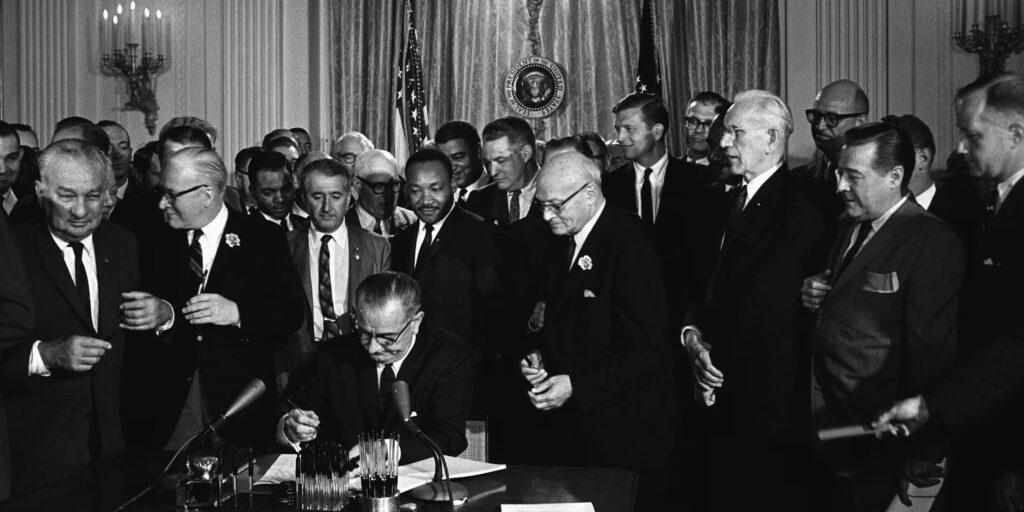
The Civil Rights Act of 1964 did not invent a new theory of rights; it enforced the old one. It stood on the constitutional footing laid in 1866 and secured in the 14th Amendment—federal intervention when states or state-like actors deny equal protection to the descendants of American chattel slavery.
For 48 days, that remedial logic remained intact.
Then President Lyndon B. Johnson signed Executive Order 11246. Without a constitutional amendment and without congressional redesign of the Civil Rights Act, an administrative layer was added, introducing “affirmative action” and expanding coverage to aggregated “minority” categories. Executive Order 11246 required that every federal contract include this clause:
“The contractor will not discriminate against any employee or applicant for employment because of race, color, religion, sex, or national origin.”
That sentence is the legal backbone of modern federal contracting compliance. What had been a focused repair mechanism for freedmen and their posterity was reframed as a broad diversity program.
The Constitution did not change.
The statute did not change.
Administration did.
Administrative Redirect–It is a Measurable Theft of Constitutinally Promised Repair
Nowhere is this clearer than in federal contracting. Black Americans—descendants of U.S. chattel slavery—receive just over 1% of federal contracting dollars. Meanwhile, aggregated “minority” categories receive roughly 15%. A remedy designed to repair a foundational injustice has been diluted into demographic management, leaving its original beneficiaries last in line.
The same drift appears in college scholarships and educational set-asides. Programs justified in the language of civil rights routinely distribute benefits across broad racial or ethnic classifications, while the community that endured slavery, Black Codes, Jim Crow, and state terror continues to trail in wealth, homeownership, and institutional access.
This outcome is not mysterious. It is the predictable result of severing remedial law from its historical anchor.
Why Precision Matters Now
Reconstruction lawmakers did not write immigration policy. They wrote protection into the Constitution because states were actively dismantling freedom. The Supreme Court acknowledged that purpose. Congress carried it forward. What interrupted the process was not legal intent—but administrative redirection.
AR1870 insists on clarity because clarity restores power. Repair requires precision. And precision begins with telling the truth about what the law was written to do—and for whom. Reconstruction was not a metaphor.
It was a mandate.
And it remains unfinished.
American Renewal 1870
Guarding the Promise of Reparative Justice