“The Tragedy at Ebenezer Creek”
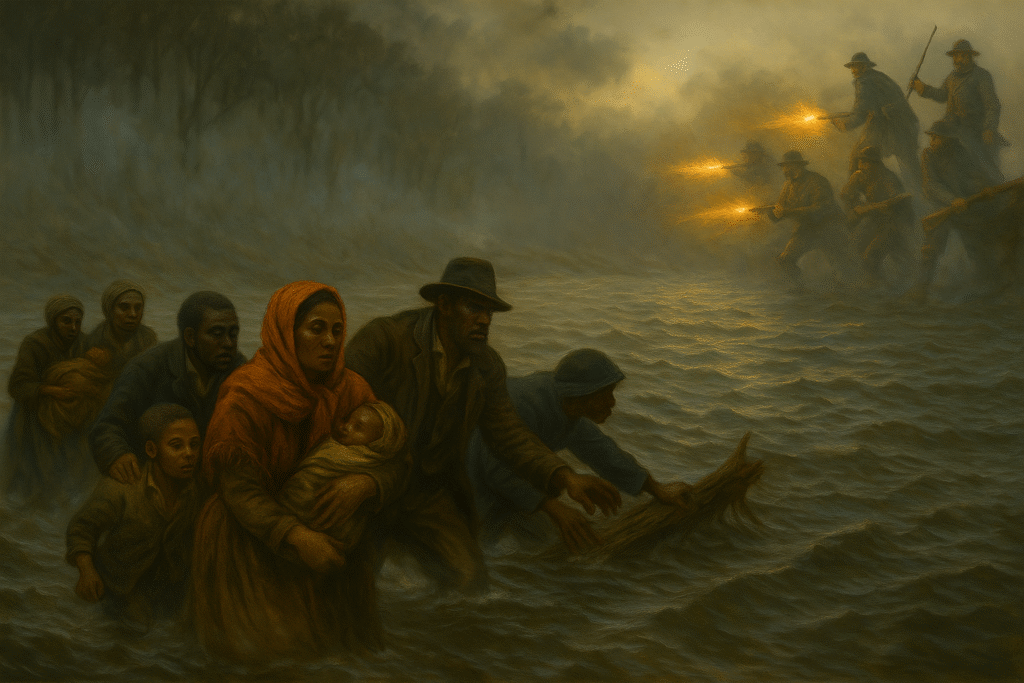
In December 1864, as Union General William T. Sherman’s troops marched through Georgia, thousands of newly freed Black men, women, and children followed the army — trusting it as a moving line of protection. They had escaped plantations, risked bullets, and starved their way toward freedom.
When Sherman’s forces reached Ebenezer Creek, near Savannah, the army built a pontoon bridge to cross. But once the last Union soldier was over, the bridge was suddenly cut away — stranding the freed people on the opposite bank.
Confederate cavalry soon arrived.
In the panic that followed, thousands tried to swim for safety. Some were shot in the water. Others drowned with their children in their arms.
Nearly 4,000 Black men, women, and children died that day — the largest single loss of Black life on American soil before Tulsa, Rosewood, or any 20th-century massacre.
News of the slaughter spread quickly. Even Union soldiers were outraged. Secretary of War Edwin M. Stanton traveled to Savannah to confront Sherman and to investigate how such a tragedy could have happened.
It was that moment of moral reckoning that led Stanton and Sherman to meet with a delegation of twenty Black ministers and community leaders on January 12, 1865.
The Ministers Speak
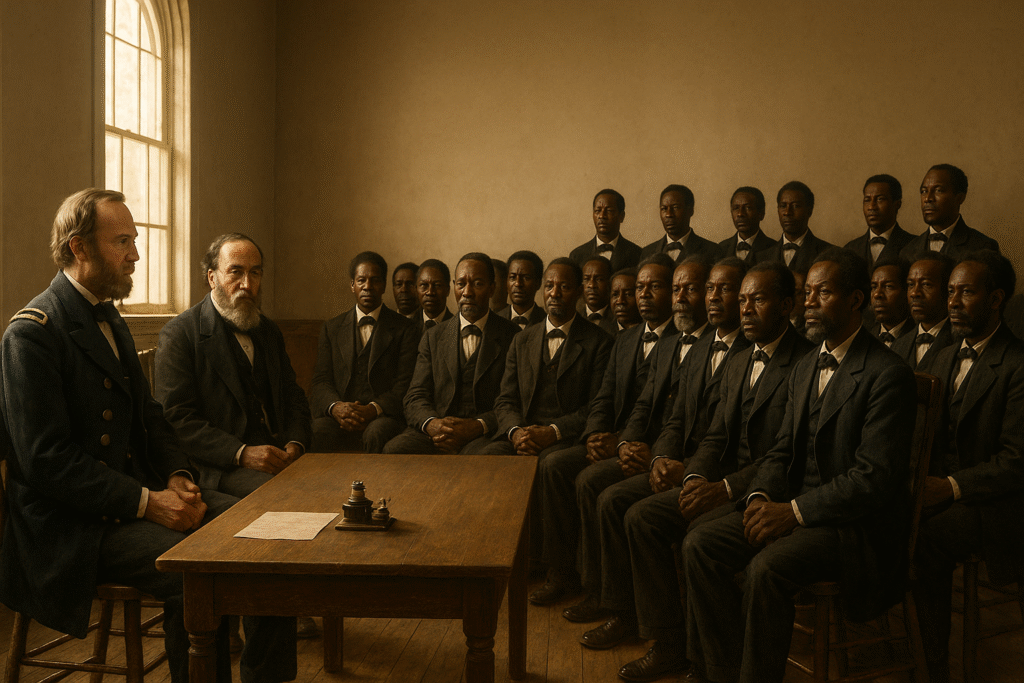
Their spokesman was Rev. Garrison Frazier, a 67-year-old Baptist elder who had purchased his freedom only eight years earlier. The men stood before two of the most powerful figures in the Union army — not as victims, but as representatives of a people newly freed and determined to survive.
When Stanton asked what freedom meant to them, Frazier answered plainly:
“Freedom, sir, is taking us from under the yoke of bondage and placing us where we could reap the fruit of our own labor and take care of ourselves and assist the Government in maintaining our freedom.”
When Sherman asked how they wished to live, Frazier’s reply became one of the most consequential statements in American history:
“The best way we can take care of ourselves is to have land, and turn it and till it by our own labor — and we can soon maintain ourselves and have something to spare.”
Within days, Sherman issued Special Field Order No. 15. Acording to the Book “From Here to Equality” by Dr. Sandy Darity And Kirsten Mullen:
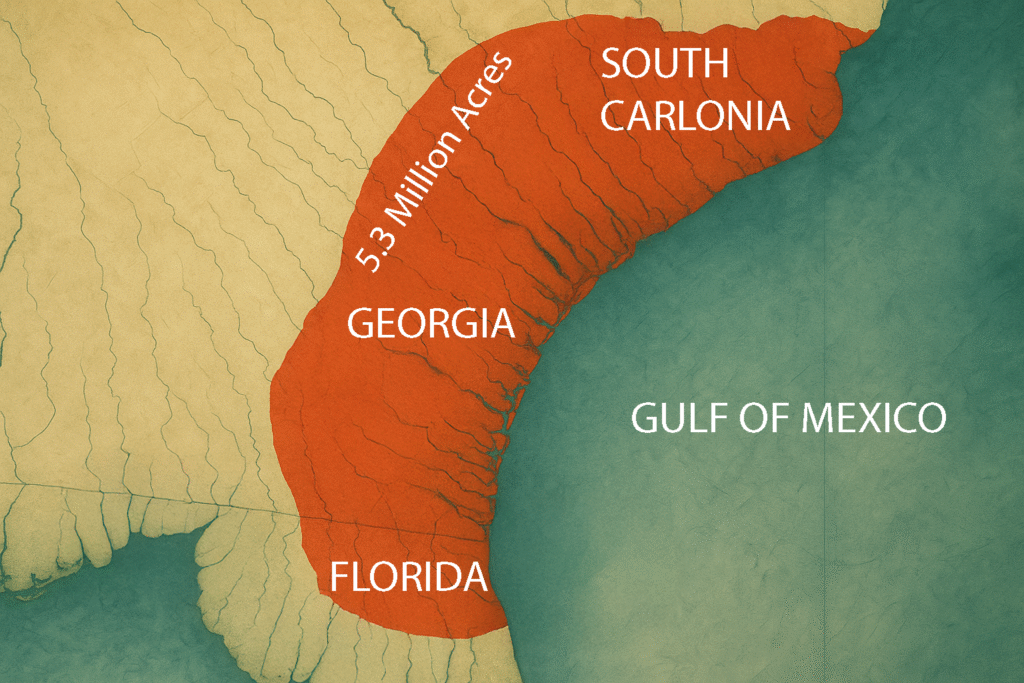
“Sherman’s Special Field Order No. 15 allotted a continuous thirty-mile wide band of confiscated land for the exclusive use of the previously enslaved. It stretched across the coast of South Carolina, beginning at Charleston, and extended through Georgia and down to the northern portions of Florida. The distance from “the islands from Charleston south the abandoned rice-fields along the rivers for thirty miles back from the sea [to] the country bordering the SaintJohns River Fla.” is 341 miles.
The Florida allotment was bounded bt the Atlantic coast and the Saint Johns River, about twenty miles west, which undulates through or runs alongside twelve counties covering some ninety-five miles. By our calculations, some 1,900 square miles lie between the river and the ocean. Each of those square miles is made up of 640 acres, which means that in Florida alone more that 1,216,000 acres of land would have been available to freedmen.
This unparalleled federal land distribution would have made approximately 5.3 million acres of land in three states available to refugees from the war and to the formerly enslaved. In fact, 40,000 freedmen did settle on 400,000 acres of land.
…A complete allocation of the full acreage specified in Sherman’s order would have created a vast zone of land occupied by those formerly enslaved–virtual costal “Black Belt”–with a uniquely equal foundation for wealth accumulation among the formerly enslaved….“— the origin of the phrase “Forty Acres and a Mule.”
It was the first official act of reparations in U.S. history, born not in Congress, but in the moral conviction of the Black ministry.
The Promise and the Betrayal
That promise was short-lived.
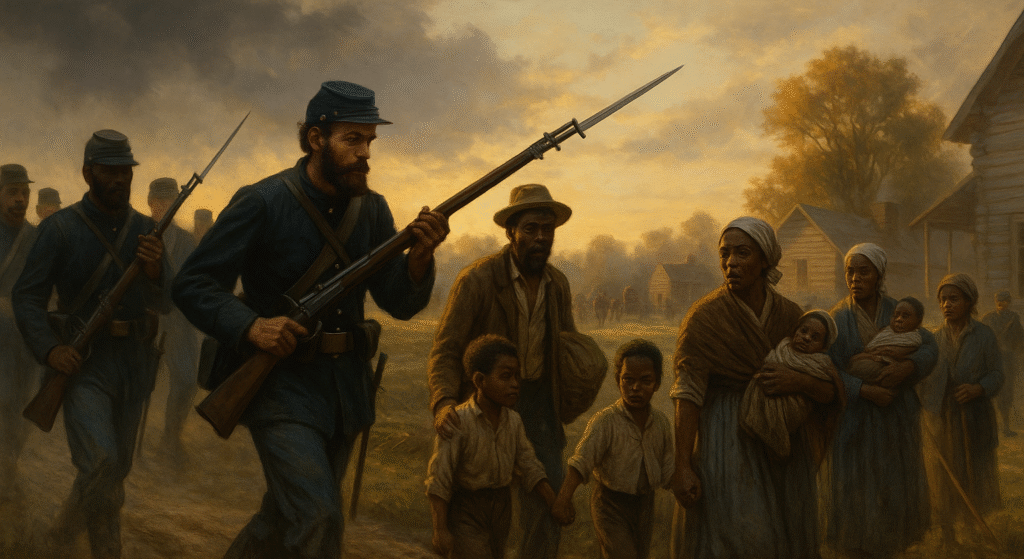
President Andrew Johnson, the Democrat who succeeded Lincoln, rescinded the order by executive action later that same year. The land was returned to Confederate planters — and the freedmen who had cleared, planted, and built their new farms were driven from their homes at the point of a bayonet.
Where families once tilled soil in freedom, soldiers marched through their fields, forcing them to abandon cabins they had raised with their own hands.
Frederick Douglass, a man who had lived the nightmare and survived to tell it, declared:
“The world has never seen any people turn loose to such destitution as were the four million slaves of the South. They were free without roofs to cover them or bread to eat or land to cultivate, and as a consequence died in such numbers as to awaken the hope of their enemies that they would soon disappear.”
The covenant forged at Ebenezer Creek and Savannah was broken — not by war, but by politics and betrayal.
A Lesson for the Church Today
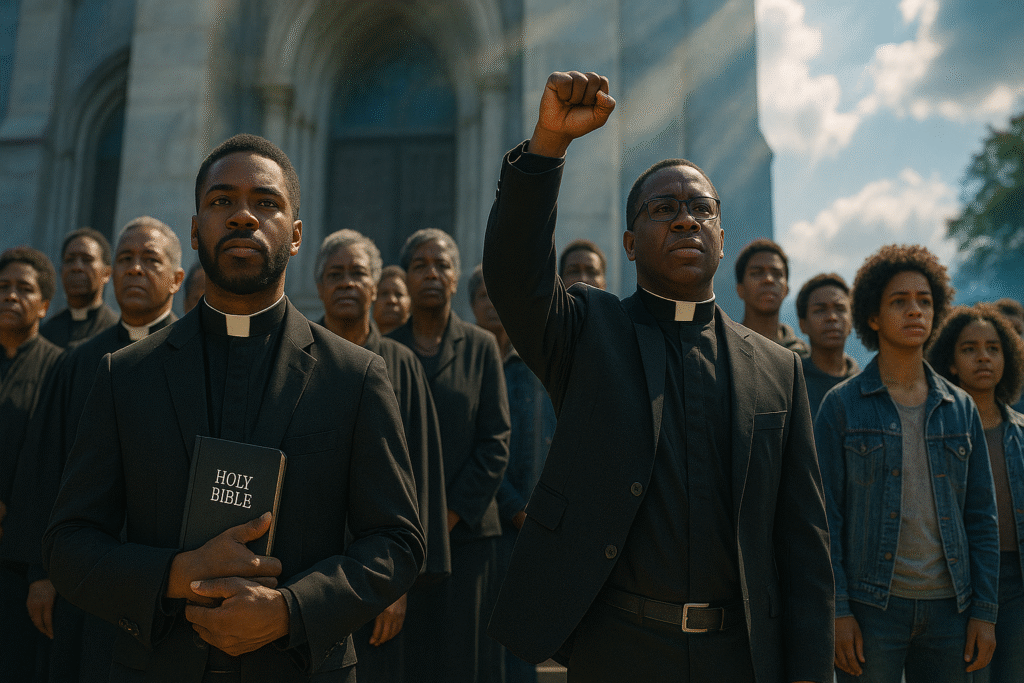
Now, in 2025, America faces another moral test.
The Episcopal Diocese of Virginia pledged $10 million toward reparations four years ago — a commitment meant to model justice for the nation. Yet progress has stalled. Committees debate. Reports gather dust. And once again, those waiting for repair are told to wait longer.
Meanwhile, the Black Church — the institution born from those very ministers’ courage — is losing members at a historic rate. Younger generations are searching for faith with action, worship with consequence, and leadership that connects morality to justice.
The opportunity is clear.
If modern clergy — Black, white, and allied — reclaimed the moral authority that those twenty ministers exercised in 1865, they could do what no institution has yet achieved: make reparations a moral, not partisan, movement.
Imagine a national coalition of churches calling on presidential candidates to restore Field Order 15 by Executive Order — symbolically undoing Johnson’s betrayal and setting the tone for federal lineage-based repair.
Such a call could rejuvenate the Church, rally the grassroots, and reconnect generations around a shared moral mission.
Just as in Savannah, faith could once again lead policy — not follow it.
American Renewal 1870
Guarding the Promise of Reparative Justice