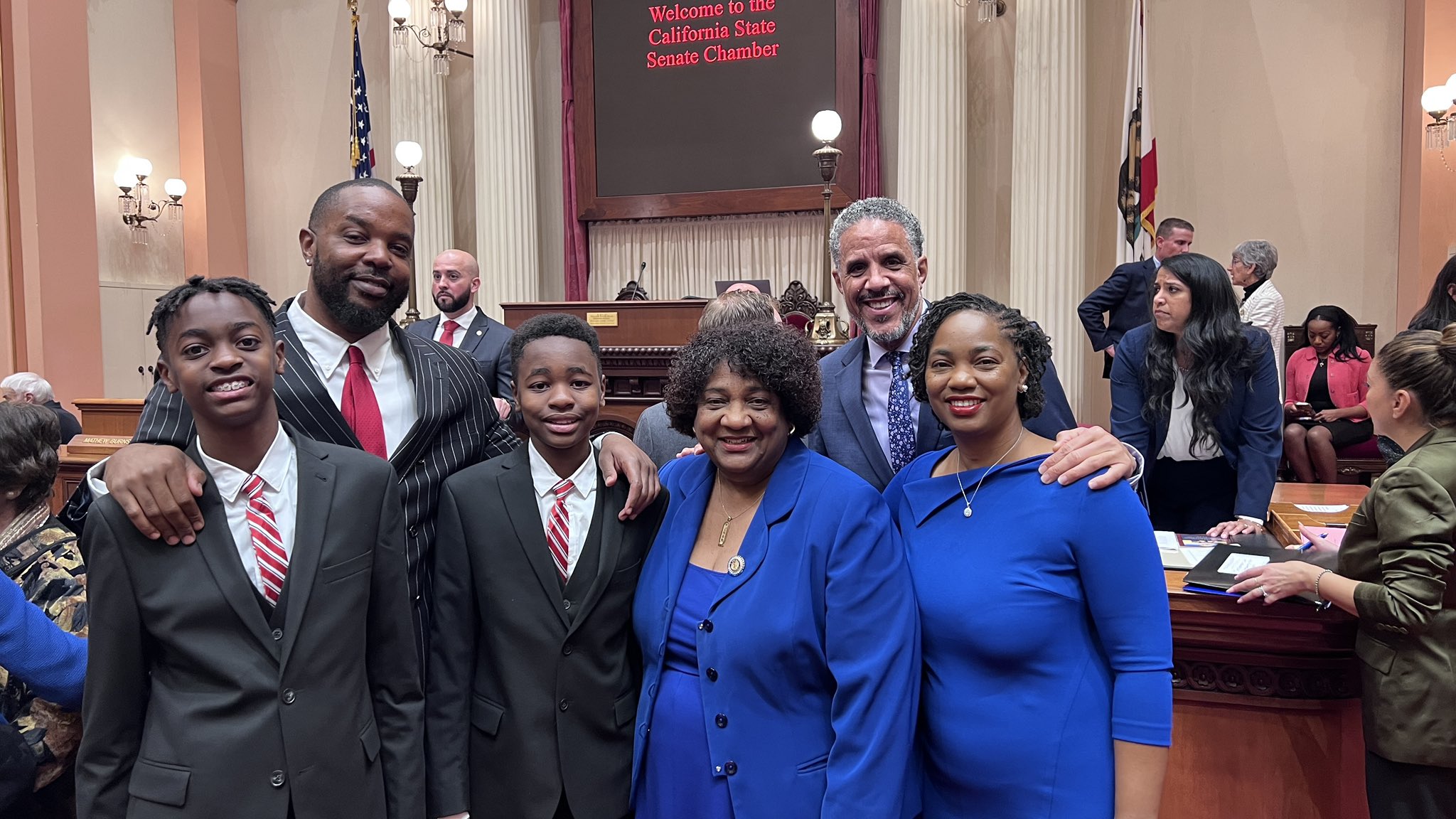
When California State Senator Dr. Akilah Weber Pierson authored Senate Bill 518, she did more than pass a bill, she advanced a generational promise. In October 2025, Governor Gavin Newsom signed her legislation into law, officially creating the Bureau for Descendants of American Slavery, the nation’s first permanent state agency devoted to repairing the harm inflicted on Black Americans whose ancestors were enslaved in the United States.
The Bureau’s mission is as clear as it is historic: to verify lineage, coordinate reparative programs, and educate the public on the enduring legacies of redlining, gentrification, and systemic exclusion. It represents not just recognition, but the building of infrastructure for repair, something that every state committed to justice should follow.
The Lineage of Leadership
What makes this achievement even more powerful is the lineage behind it. Dr. Akilah Weber Pierson is the daughter of Dr. Shirley Weber, California’s trailblazing Secretary of State and the author of Assembly Bill 3121, the 2020 legislation that created California’s Reparations Task Force. While Dr. Shirley Weber did not serve on the task force itself, her vision established the legal framework that led to its groundbreaking recommendations. Five years later, her daughter transformed those recommendations into a standing institution. Together, they form a bridge between research and realization, proving that reparative justice can be both visionary and concrete.
Their work has reverberated far beyond California. Across the nation, reparationists and policy advocates have drawn strength from their example—including American Renewal 1870, the organization that helped craft and pass Washington State’s own lineage-based reparations study in 2025. Inspired by the Webers’ model, AR1870 will continue to advocate for the creation of a Washington Bureau for Descendants of U.S. Chattel Slavery—an office capable of transforming our state’s study into sustainable programs that educate, restore, and empower the Black American Descendant Community.
What Newsom Vetoed — The Bills of Substance
While SB 518 marks undeniable progress, the full promise of reparations requires tangible programs to accompany its administrative foundation. Governor Newsom’s pen, however, stopped short of that goal. He vetoed several bills that would have provided measurable benefits to descendants of enslaved people:
- AB 7: Would have allowed (though not required) public and private colleges to grant admissions preference to applicants who are descendants of U.S. slavery. Newsom labeled it “unnecessary,” asserting that universities already possess discretion over admissions. (Source: Politico)
- AB 57: Would have set aside 10 percent of funds in a first-time homebuyer assistance program specifically for descendants of enslaved persons. Newsom vetoed it, citing concern that an “ancestry-based set-aside” could incur legal risk. (Source: AP News)
- SB 1050: Would have allowed families whose property was taken by racially motivated eminent domain to claim restitution, compensation, or return of property. Newsom vetoed it, claiming the state lacked an existing agency capable of implementation. (Source: AP News)
In short: admissions preference, home-assistance set-asides, and property restitution—these were bills meant to deliver actual repair. They died under the governor’s pen. Meanwhile, Newsom did sign SB 518 (creating the Bureau. See AR 1870 article titled: Newsom Vetos Tangible Reparations, Signs Symbolic Bureau–Washington Must Learn The Lesson) and a companion measure funding genealogical verification through the California State University system.
Thus the paradox: the Bureau exists, but its tools of restoration do not.
The Legislature’s Moment of Truth
California’s legislative leaders now hold both a window and a weapon.
Under state law, the Legislature has only 60 days from a gubernatorial veto to vote on an override. Doing so requires a two-thirds majority in both chambers—54 votes in the 80-member Assembly and 27 in the 40-member Senate. Although veto overrides are rare (the last successful one occurred in 1979), this is no ordinary moment. The 2028 Presidency is at stake.
The governor’s national aspirations give lawmakers unprecedented leverage. Overriding these vetoes would send a clear message: symbolic progress is not enough, and any leader seeking the highest office in the land must stand behind tangible repair for descendants of American slavery. California’s elected representatives now have the chance to match Dr. Weber Pierson’s courage with their own.
Building Beyond the Bureau
SB 518 gave California a permanent infrastructure for lineage-based justice; the vetoed bills would have supplied the resources and restitution to make that infrastructure real. The state’s next step must be to fund the Bureau, restore the vetoed measures, and align action with intention. Every day the Legislature waits, the 60-day clock ticks closer to erasing an opportunity to move from recognition to repair.
The Call to Washington and Beyond
From Sacramento to Seattle, the work of reparations is entering a new phase, one defined by implementation. American Renewal 1870 stands ready to support Washington State in building a Bureau modeled on California’s, learning from its triumphs and its tests. The Webers’ legacy shows that lineage matters, that persistence yields structure, and that Black American descendants can and must lead the institutions that define their future.
At American Renewal 1870, we salute Dr. Akilah Weber Pierson and Dr. Shirley Weber for their generational vision, and we urge California’s Legislature to honor their leadership by seizing this moment—override the vetoes, fund the Bureau, and finish the work.
Because repair must not only be studied or symbolized—it must be secured.
American Renewal 1870
Guarding the Promise of Reparative Justice