Washington State launched a historic reparations study. But newly surfaced internal emails raise deep questions
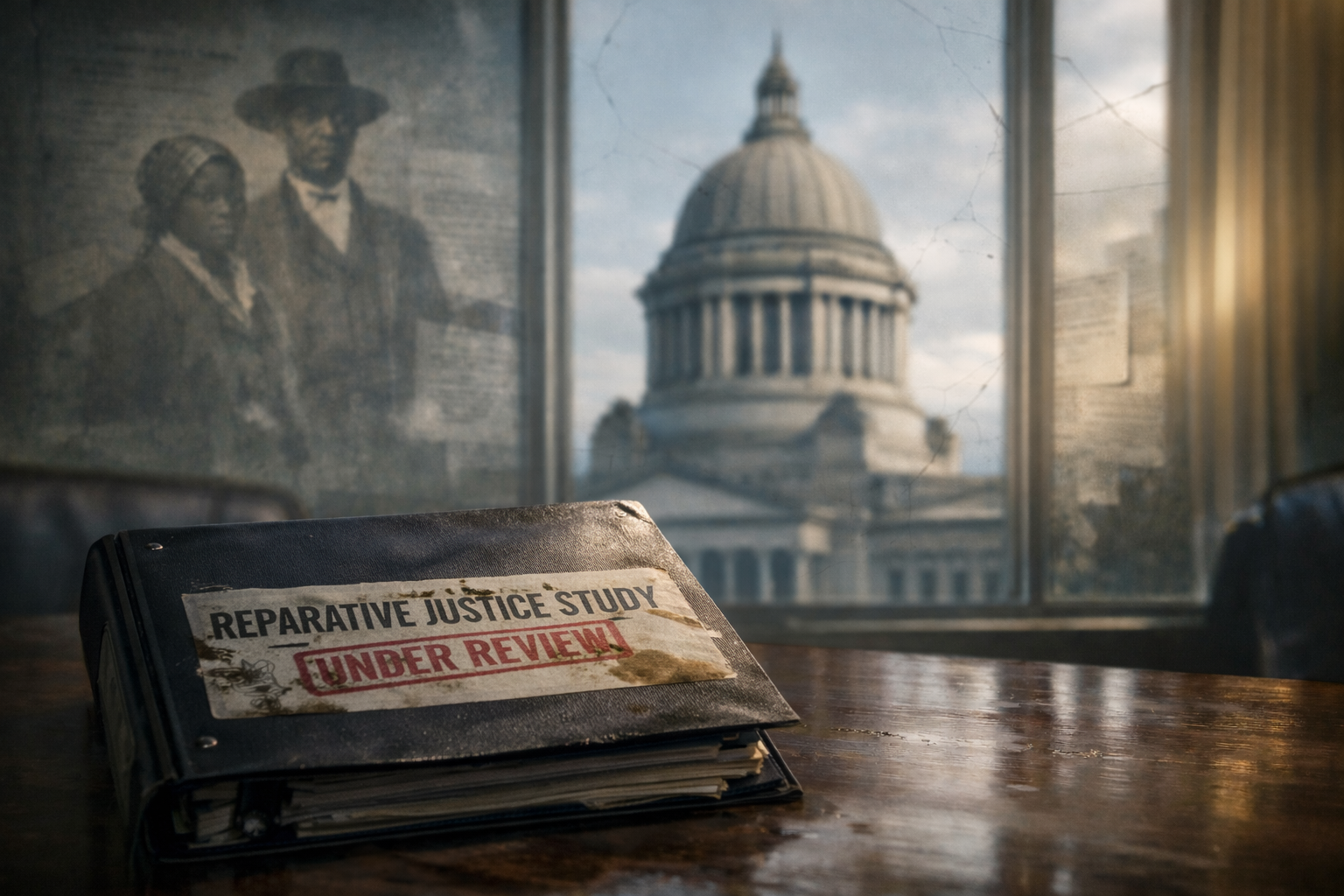
The Charles Mitchell & George Washington Bush Reparations Study was presented as a landmark opportunity—an unprecedented, state-authorized process to examine harms done to Descendants of U.S. Chattel Slavery and help shape pathways toward repair.
For many, this was not just policy.
It was history.
It was accountability.
It was trust.
But trust in any public process depends on more than headlines and legislative wins.
It depends on integrity.
And when integrity is questioned, silence is not accountability.
THE PROMISE: REPAIRING HISTORIC HARM
Washington’s study was supposed to do something rare: move descendant-centered reparative policy from rhetoric into lawful public process.
That mission matters.
For generations, Black descendants have watched promises delayed, diluted, or redirected. A study of this magnitude should have represented a new standard, one rooted in transparency, qualifications, lawful implementation, and community legitimacy.
Through a Public records request, American Renewal 1870 discovered that internal communications reveal serious concerns from within the process itself.
One advisory participant explicitly warned that the process risked harming the community it claimed to serve, writing:
“My understanding of reparation is to repair harm. This process is intended to repair harm that has been done not to create more harm.” Dr. Linda Smith
That warning alone should have triggered rigorous public accountability.
But what followed raises even bigger concerns.
THE EMAILS: COMMUNITY CONCERN OR DAMAGE CONTROL?
As concerns mounted over the apparent successful bidder, one respected voice called for a pause, not cancellation, not sabotage, but discernment.
The reasoning was clear:
“No decision is worth damaging an already damaged relationship.” Paula Sardinas
This was not an attack on reparations.
It was a warning about process legitimacy.
Yet another internal response emphasized something striking:
“We need to remember that we followed the process, and we have to act like it. When we over explain it makes it look like we did something wrong.” Ed Prince Executive Director Commission on African American Affairs.
Read that again.
Not: “Let’s ensure public trust.”
Not: “Let’s review concerns transparently.”
Not: “Let’s verify confidence.”
Instead, the emphasis appears centered on perception.
For descendants, advocates, and taxpayers alike, that distinction matters.
Because public trust is not preserved by appearing credible.
It is preserved by being credible.
WHEN PROCESS BECOMES THE STORY
A reparations study cannot afford even the appearance of compromised legitimacy.
Why?
Because this process is bigger than one contract.
It sets precedent.
If Washington’s first major descendant-centered reparative framework becomes associated with opacity, dismissiveness, or procedural defensiveness, opponents of reparations nationwide will weaponize that failure for years.
That is why accountability is not obstruction.
It is protection.
The issue is no longer simply who won a bid.
The issue is whether lawful intent, public confidence, and descendant trust were treated as sacred, or secondary.
THIS IS BIGGER THAN TRUCLUSION
This moment is not about one organization alone.
It is about whether Washington State’s reparative action process can withstand scrutiny equal to the moral weight it claims to carry.
If concerns from within the advisory ecosystem were minimized…
If calls for pause were framed as dangerous…
If optics mattered more than explanation…
Then the public has every right to ask:
Was this process designed to build trust—or simply survive criticism?
AR1870’S POSITION: WE DO NOT OPPOSE REPARATIONS. WE OPPOSE COMPROMISED IMPLEMENTATION.
American Renewal 1870 did not help advance lineage based reparative policy so that descendants would be told to trust systems without scrutiny.
We support the study.
We support repair.
But support does not mean silence when legitimate concerns emerge.
Real accountability means asking hard questions before flawed implementation becomes permanent precedent.
Because once trust is broken in a process this important, the damage extends far beyond one award.
It damages belief itself.
WHAT AR1870 DEMANDS NOW:
1. Immediate pause and independent review of procurement integrity
2. Full transparency regarding scoring, qualifications, and process safeguards
3. Public assurance that descendant trust, not bureaucratic preservation, is the priority
4. Protection of the study’s legitimacy before final implementation moves forward
THE BOTTOM LINE
Reparations cannot be built on compromised trust.
If this study is truly about repair, then scrutiny should strengthen it—not threaten it.
And if transparency is uncomfortable, the answer is not less accountability.
It is more.
The people of Washington, and the descendants this study was meant to serve, deserve answers.
Sign the petition. Demand integrity. Protect the mission before the mission is used against itself